Papers presented at world congresses
WORLD PHYSIOTHERAPY CONGRESS – WPTC
The World Physiotherapy Congress brings together the global physiotherapy community every 2 years. Hosted in a different country each time, it is organised in collaboration with university departments and physiotherapy associations worldwide to share the latest developments in the field.
The programme includes clinical workshops, lectures and discussions, demonstrations of modern equipment and devices, new treatment methods and services, and presentations of the latest scientific and research papers across interventions and conditions.
Its purpose is to keep physiotherapists informed and maintain a high level of professional knowledge.
TherapyLab’s team has presented scientific reviews and research at the World Physiotherapy Congress.
PAPERS PRESENTED AT WORLD CONGRESSES
1. THE EFFECT OF THERAPEUTIC EXERCISE AND INSTRUMENT-ASSISTED MYOFASCIAL RELEASE ON SCAPULAR DYSKINESIS IN PATIENTS WITH ROTATOR CUFF-RELATED SHOULDER PAIN
A. Z. Cheimonidou1, K. Fousekis2, G. Papathanasiou, G. Tsatsakos4, P. Rentzias, G. Ploutarchou1, D. Lamnisos1, D. Stasinopoulos2
- European University Cyprus, Physiotherapy, Nicosia, Cyprus
- University of Patras, Physiotherapy, Aigio, Greece,
- University of West Attica, Physiotherapy, Athens, Greece,
- TherapyLab Physiotherapy Clinics, Athens, Greece
Introduction:
Scapular dyskinesis is a movement dysfunction associated with rotator cuff-related shoulder pain (RCRSP). Rehabilitation primarily focuses on scapula-focused therapeutic exercise. A review of the literature identified conflicting evidence on physiotherapy interventions in patients with RCRSP and scapular dyskinesis. In addition, no studies were found on the effect of therapeutic exercise and instrument-assisted myofascial release (MFR) on this dysfunction. The present research study addresses this gap in the scientific literature.
Purpose:
The aim of this study was to investigate the effect of therapeutic exercise and instrument-assisted MFR on scapular dyskinesis in patients with RCRSP.
Methods:
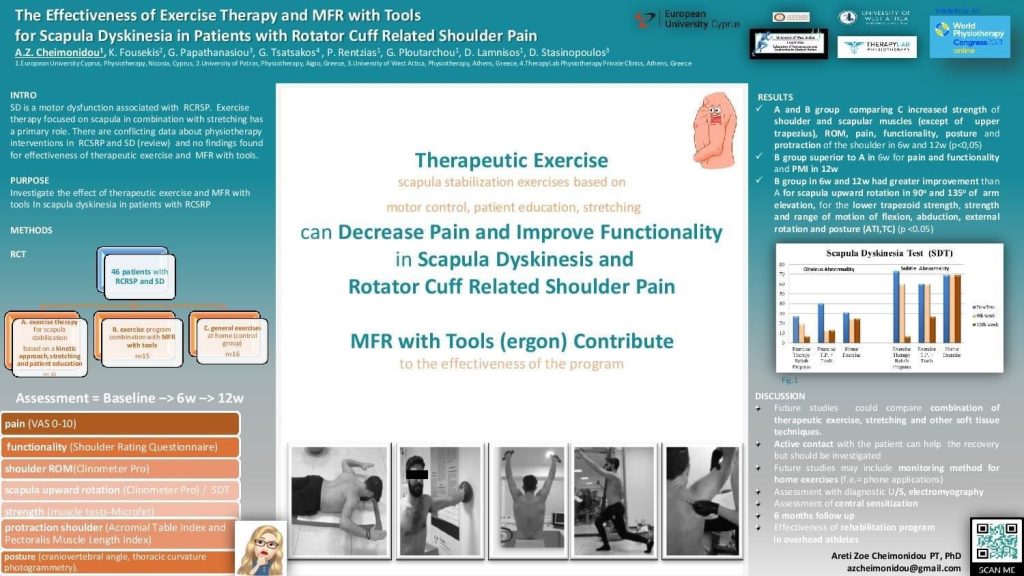
Forty-six patients with RCRSP and scapular dyskinesis participated. They were randomly allocated to 2 different exercise groups: (A) motor control-based scapular stabilisation exercise therapy, a stretching programme and patient education; (B) the same programme combined with instrument-assisted MFR; (C) general home exercises (control group). Assessments were conducted at baseline, after 6 weeks and after 12 weeks of the physiotherapy programme: pain (VAS 0–10), function (shoulder questionnaire), shoulder ROM (Clinometer Pro), scapular upward rotation (Clinometer Pro), strength (muscle testing – Microfet), shoulder protraction (Pectoralis Minor Index and Acromion-to-Bed Index), and posture (cervicothoracic angle and thoracic curvature – photometry).
Results:
Statistically significant differences (p < 0.05) were observed for group A (exercise therapy) and group B (exercise therapy and instrument-assisted MFR) compared with the general home exercise group after 6 and 12 weeks. Significant improvements (p < 0.05) were found in shoulder and scapular muscle strength (except the upper trapezius), ROM, pain, function, posture and shoulder protraction. Scapular dyskinesis also improved by 53% and 56% for groups A and B respectively at 12 weeks. The exercise and MFR group (B) appeared superior to the exercise group (A) at week 6 for pain and function. At 6 and 12 weeks, the combination of MFR and exercise therapy also produced statistically significantly greater improvements (p < 0.05) than exercise alone (group A) in scapular upward rotation at 90° and 135° of arm elevation, lower trapezius strength, and strength and range of motion in flexion, abduction and external rotation, as well as posture.
Conclusion:
Motor control-based therapeutic exercise – scapular stabilisation exercises – combined with patient education and stretching can reduce pain and improve function in patients with scapular dyskinesis and RCRSP. Instrument-assisted myofascial release contributes to the effects of the therapeutic exercise programme.
#wcpt2021 #scapuladyskinesia #shoulderpain #rotatorcuff #therapeuticexercise#myofascialrelease #research #rct #therapylabacadem
2. “CROSS-CULTURAL ADAPTATION AND RELIABILITY OF THE BAGE QUESTIONNAIRE IN GREEK”
Background:
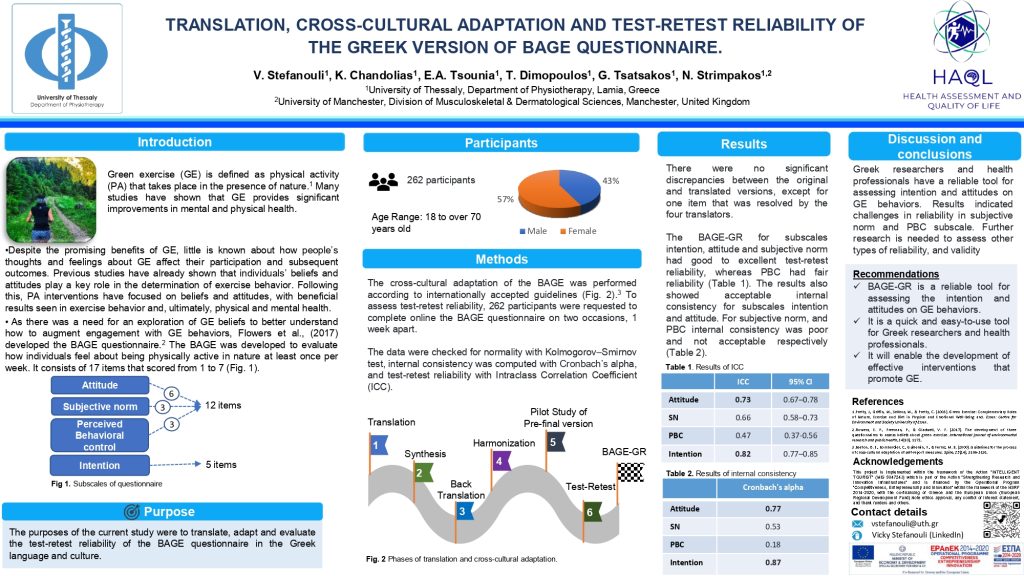
Green exercise (GE) is defined as physical activity (PA) undertaken in natural environments. Many studies have shown that GE provides significant improvements in mental and physical health. Despite the promising benefits of GE, little is known about the thoughts and feelings that influence people’s participation and the subsequent benefits they may gain. Previous studies have already shown that individuals’ beliefs and attitudes play a key role in determining their exercise behaviour. In line with these findings, GE interventions have focused on individuals’ beliefs and attitudes, with beneficial effects on behaviour and, ultimately, physical and mental health. As there was a need to investigate beliefs about GE to better understand how participation in GE could be increased, Flowers et al. (2017) developed the BAGE questionnaire. BAGE was developed to assess how individuals feel about being physically active in natural environments at least once a week. It consists of 17 items scored from 1 to 7. The overall score is divided into 4 subscales: intention (5 items), attitude (6 items), subjective norm (3 items) and perceived behavioural control (PBC) (3 items).
Purpose:
The purpose of this study was to translate, adapt and assess the reliability of the BAGE questionnaire in Greek.
Methodology:
Cross-cultural adaptation of BAGE was conducted in accordance with the international guidelines of Beaton et al. (2000). Reliability was assessed using a test–retest method: 262 participants (112 men and 150 women) were asked to complete the BAGE questionnaire twice, 1 week apart. Data were tested for normality using the Kolmogorov–Smirnov test, internal consistency was calculated using Cronbach’s alpha, and test–retest reliability using the intraclass correlation coefficient (ICC).
Results:
There were no significant discrepancies between the original and translated versions, apart from one item that was resolved by the four translators. The intention, attitude and subjective norm subscales showed good to excellent reliability (intention ICC (2,1) = 0.82, 95% CI = 0.77–0.85; attitude ICC (2,1) = 0.73, 95% CI = 0.67–0.78; subjective norm ICC (2,1) = 0.66, 95% CI = 0.58–0.73), while PBC showed partial reliability (ICC (2,1) = 0.47, 95% CI = 0.37–0.56). The results also demonstrated acceptable internal consistency for the intention (Cronbach’s alpha = 0.87) and attitude (Cronbach’s alpha = 0.77) subscales. Internal consistency was poor for subjective norm (Cronbach’s alpha = 0.53) and perceived behavioural control (Cronbach’s alpha = 0.18).
Conclusion:
BAGE-GR is a quick and reliable tool for researchers and healthcare professionals to assess intentions and attitudes towards GE behaviour. It will support the development of interventions that promote physical fitness.
3. THE EFFECT OF THE COVID-19 PANDEMIC LOCKDOWN ON PATIENTS WITH CHRONIC MUSCULOSKELETAL PAIN IN GREECE
P. Bilika1, G. Tsatsakos2, Z.A. Chimonidou2, S. Argyrou3, K. Konstantinou3, G.G. Koutras4, S. Gigourtakis5, E. Kapreli1
University of Thessaly, Brain Rehab Research Group, Laboratory Research Physiology and Rehabilitation Research Laboratory, Physiotherapy Department, Lamia, Greece, 2 TherapyLab Physiotherapy Private Clinics, Athens, Greece, 3 Makris & Konstantinou Physiotherapy Private Clinic, Lamia, Greece, 4 Koutras Georgios Physiotherapy Private Clinic, Thessaloniki, Greece, Private Physiotherapy Clinic, 5 Gigourtakis Spyros, Heraklion, Crete, Greece
Background: The Covid-19 pandemic changed people’s daily routines in almost every part of the world, particularly during lockdown. With no previous experience to draw on, there was concern for patients with chronic musculoskeletal pain who were not receiving their usual healthcare, such as physiotherapy. It was hypothesised that these patients could be further affected during the Covid-19 restriction period by various factors, including reduced physical activity, limited access to medication and specialist advice, the risk of unemployment and financial consequences, and finally isolation and the adoption of harmful habits such as an unhealthy diet and a balanced sleep routine (Parker et al., 2017; Geneen et al., 2017; Timmerman et al., 2016). Although it is well known how all these factors can contribute to chronic pain, there is no evidence concerning the impact that a period of self-isolation could have on patients with chronic musculoskeletal pain.
Purpose: The aim of this study was to investigate the effect of certain socioeconomic, psychological and lifestyle factors on the health status of patients with chronic musculoskeletal conditions during the Covid-19 pandemic lockdown in Greece.
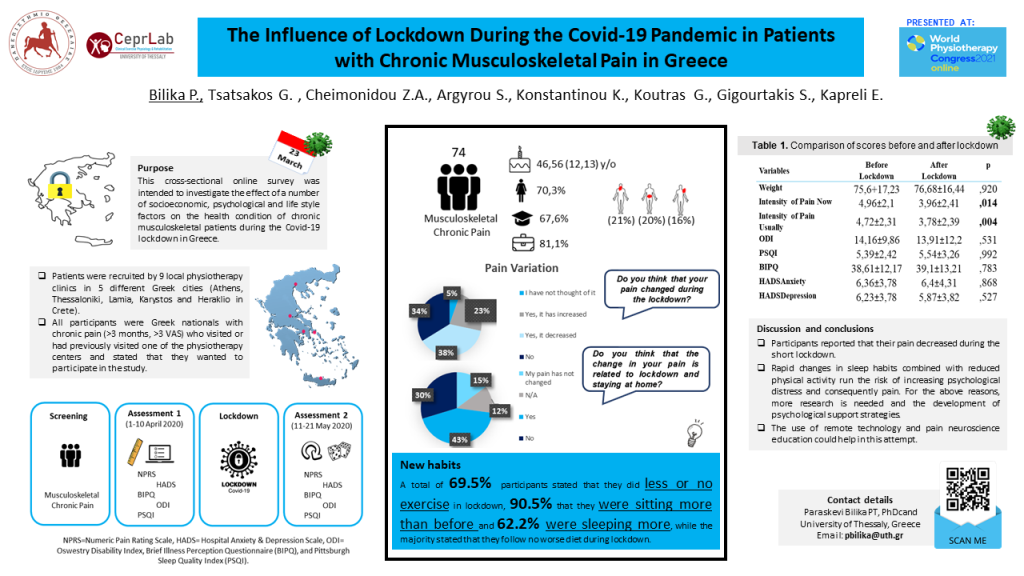
Methods: Patients aged >18 years with chronic musculoskeletal pain (>3 months, >3 VAS) who had attended physiotherapy before lockdown were included in the study. The questionnaire, created using Google Forms, was emailed to 9 local physiotherapy clinics in 5 different Greek cities (Athens, Thessaloniki, Lamia, Karystos and Heraklion, Crete). Each participant completed the survey twice: first during the first week of lockdown, and secondly during the first week after the restrictions ended (a period of 40 days). The survey included demographic data and a series of questionnaires to assess anxiety, depression, sleep, quality of life, pain behaviour, illness perceptions and function. The questionnaires were: Hospital Anxiety and Depression Scale (HADS), Brief Illness Perception Questionnaire (BIPQ), Oswestry Disability Index (ODI) and Pittsburgh Sleep Quality Index (PAQI). All participants were informed and gave their consent before taking part in the study.
Results: Seventy-four patients (46.56 ± 12.13 years) with chronic musculoskeletal pain agreed to participate. Overall, 69.5% of participants reported exercising less or not at all during lockdown, 90.5% were more inactive than before, and 62.2% slept for longer. Pain intensity decreased after the restrictions were lifted (PainB efore = 4.96 ± 2.1, Pain After = 3.96 ± 2.41, p = 0.014). We found no significant differences in HADS, BIPQ, ODI or PSQI scores. In addition, pain intensity showed a moderate positive correlation with PSQI after self-isolation (r = 0.301, p < 0.05) and with pain intensity at a new body location according to ODI after self-isolation (r = 0.465, p < 0.05).
Conclusion: In conclusion, patients with chronic pain experienced less pain during the initial lockdown measures. New habits, such as more sleep and social changes during self-isolation, probably led to less pain.
Recommendations: In the present study, patients with chronic pain did not experience a deterioration in their health status (pain and function), considering the psychosocial factors examined.
#wcpt2021 #telerehabilitation #chronicpain #lockdown #chronicmusculoskeletalpain
4. THE EFFECTIVENESS OF TELEREHABILITATION IN PATIENTS WITH CHRONIC MUSCULOSKELETAL PAIN DURING THE COVID-19 PANDEMIC AND LOCKDOWN
E. Kapreli1, G. Tsatsakos2, Z.A. Chimonidou2, Ch. Alamanos2, A. Achtypi2, A. Konstantopoulou1, E.-A. Lignou1, P. Bilika1
Πανεπιστήμιο Θεσσαλίας, BrainRehab Research Group, Laboratory Research Physiology and Rehabilitation Research Laboratory, Physiotherapy Department, Lamia, Greece,
TherapyLab Physiotherapy Private Clinics, Athens, Greece
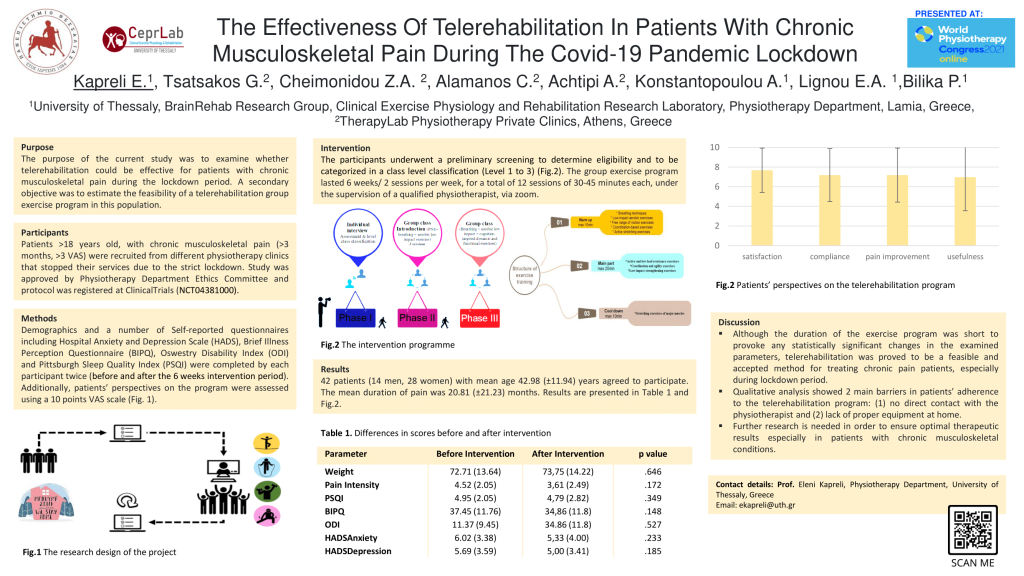
Background: The Covid-19 lockdown had a major influence on various socioeconomic factors that are vital to mental and physical health and quality of life and are associated with pain. In addition, exercise is known to be an effective treatment for reducing pain and improving activities of daily living (ADL) in patients experiencing pain due to different conditions (Ambrose and Golightly, 2015; Geneen et al., 2017). It was therefore hypothesised that a remote exercise programme could be a feasible, cost-effective and safe solution for these patients, particularly during lockdown.
Purpose: The purpose of the current study was to examine whether telerehabilitation could be effective during lockdown. A secondary aim was to assess the feasibility of a telerehabilitation exercise programme in this population.
Methodology: Patients self-isolating at home, aged >18 years and with chronic musculoskeletal pain (>3 months), were recruited from different physiotherapy clinics. The intervention programme included warm-up exercises combined with breathing techniques, low-intensity aerobic exercise, free exercises for the upper and lower limbs and trunk, balance exercises and, finally, stretching of the main limb and trunk muscles. The programme lasted 6 weeks, with 2 sessions per week, for a total of 12 sessions lasting 30–45 minutes each, supervised by a qualified physiotherapist via Zoom. Each participant completed demographic information and questionnaires assessing anxiety, depression, sleep, quality of life, pain behaviour, perceptions and pain-related function twice (during the first and last weeks of lockdown). The questionnaires were: Hospital Anxiety and Depression Scale (HADS), Brief Illness Perception Questionnaire (BIPQ), Oswestry Disability Index (ODI) and Pittsburgh Sleep Quality Index (PAQI).
Results: Forty-two patients (14 men, 28 women), with a mean age of 42.98 (± 11.94) years, agreed to participate. Their mean pain duration was 20.81 (± 21.23) months. Although pain intensity decreased, no statistically significant change was observed (Pain before = 4.52 [± 2.05], Pain after = 3.61 [± 2.49], p = 0.172). No significant differences were found in HADS, BIPQ, ODI or PSQI scores. Programme adherence was high (71.5%). Patients reported high satisfaction with telerehabilitation (7.68 ± 2.25 on a VAS scale) and a sense of pain relief due to their participation (7.18 ± 2.76 on a VAS scale). Qualitative analysis revealed two main barriers to patients’ adherence to the telerehabilitation programme:
(1) no direct contact with the physiotherapist, and
(2) lack of suitable equipment at home.
Conclusions: Although the exercise programme was too short to produce statistically significant changes in outcome measures, telerehabilitation proved a feasible and acceptable method of treating patients with chronic pain, particularly during lockdown.
Recommendations: A telerehabilitation programme, particularly under self-isolation conditions such as the Covid-19 lockdown, appears to be a feasible and promising method of managing chronic pain. However, further research is needed to ensure optimal treatment outcomes, particularly in patients with chronic musculoskeletal conditions.
#wcpt2021 #telerehabilitaion #covid19lockdown #chronicmuskuloskeletalpain