
What is joint cracking?
Joint cracking, also known scientifically as intra-articular crepitus, is the sound you hear during a sudden movement or at the end of a joint’s range.
Joint cracking has attracted plenty of theories and myths.
Let us set the record straight about intra-articular crepitus.
Myth: Joint cracking will cause permanent joint damage or even arthritis
Fact: All research has shown that, provided joint cracking is not accompanied by pain, there is no risk of causing tissue damage within the joint.
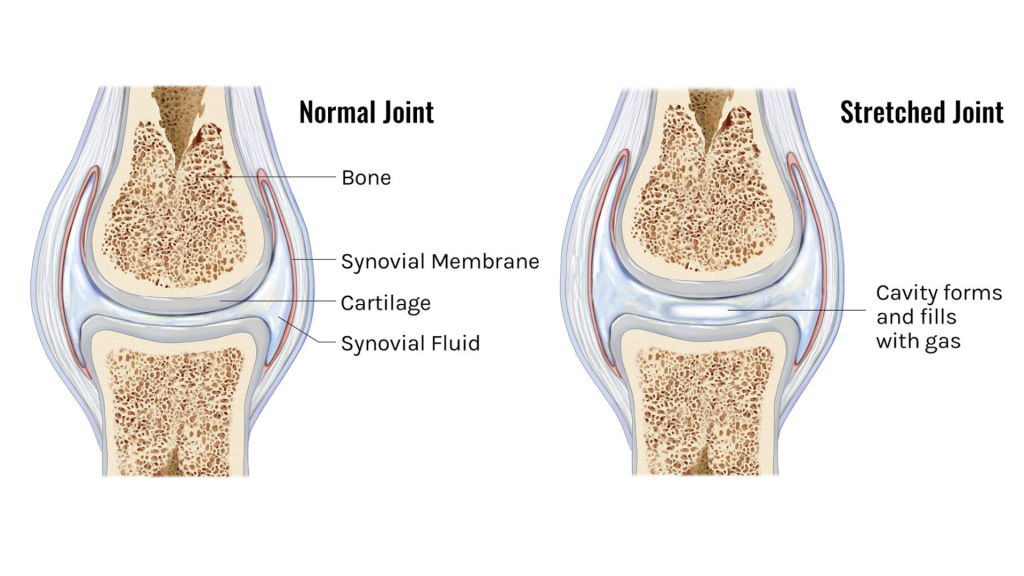
The sound you hear is nitrogen being released from small bubbles ‘bursting’ inside the joint.
Myth: Cracking your joints will increase their range of movement
Fact: People who crack a joint feel relief and an increase in joint movement.
This makes sense: when the nitrogen bubbles disappear, there is more space within the joint and less pressure at the end of its range.

After 20–30 minutes, the nitrogen bubbles form again, and things return to their previous state.
An increase in range of movement may therefore occur, but it is not permanent.
Myth: I crack my joint and, although it is uncomfortable, it ultimately does me good.
Fact: As mentioned above, joint cracking must be painless to be considered harmless.
If there is pain, there may be bone-on-bone contact, injury to the articular cartilage, or friction and/or displacement of a tendon over a bony surface.
These cases need diagnostic investigation to avoid further problems.
They should certainly avoid causing intra-articular crepitus themselves or having someone else cause it.
Myth: My physiotherapist cracked my joints, so the treatment was successful
Fact: A crack during a grade III manual therapy technique does not show that treatment has worked. It is simply a joint sound produced by a forceful movement at the end of its range.
Sometimes this cracking is contraindicated and may be an entirely inappropriate choice.
Gentler mobilisation is often clearly preferable and more beneficial for the patient.

What matters is choosing a properly trained, highly qualified and certified physiotherapist, rather than using a joint crack to judge the quality of treatment.
TherapyLab therapists who use high velocity thrust techniques within manual therapy are trained to do so and have the clinical reasoning needed before performing a forceful mobilisation.